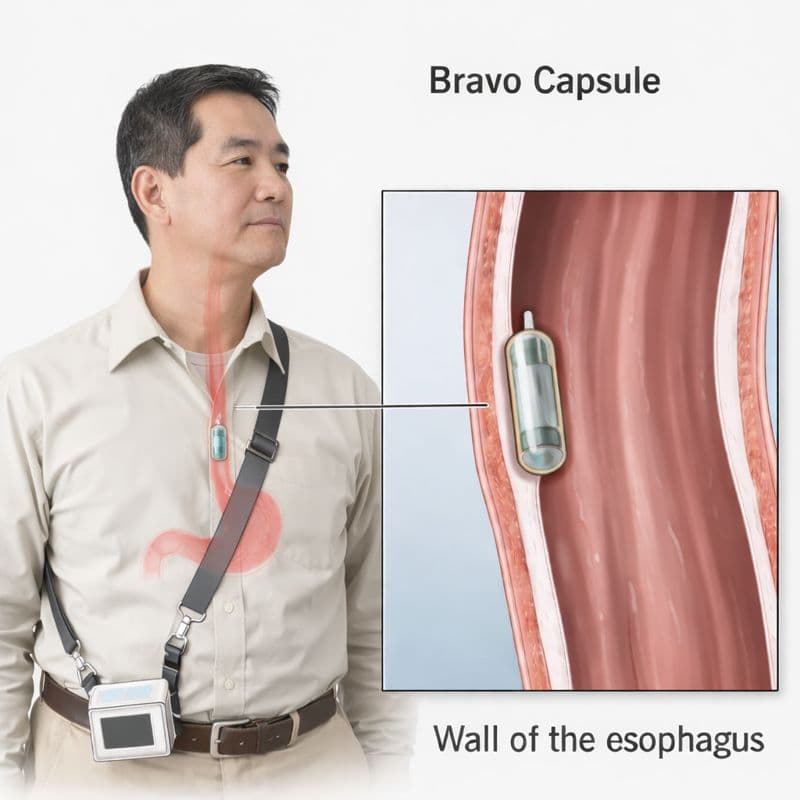
Bravo Capsule
Wireless pH Monitoring
The Bravo capsule is a wireless monitoring system for measuring acid reflux in the oesophagus. Unlike traditional catheter-based pH tests, this tiny capsule attaches temporarily to your oesophagus and transmits pH data wirelessly, allowing you to go about your normal activities during the test.
Book a ConsultationWhen is Bravo pH Monitoring Needed?
Bravo pH monitoring is a clinically recognized tool for objectively measuring acid reflux. It helps confirm or exclude gastro-oesophageal reflux disease (GERD) when the diagnosis is uncertain, and provides crucial information for treatment planning.
Indications
- Persistent heartburn despite medication
- Atypical reflux symptoms (chronic cough, hoarseness, chest pain)
- Evaluation before anti-reflux surgery
- Assessment of treatment response
- Differentiating reflux from functional heartburn
- Patients with normal endoscopy but ongoing symptoms
Advantages of Bravo Capsule
Wireless & Catheter-Free
No uncomfortable nasal catheter. The tiny capsule transmits data wirelessly to a small recorder worn on your belt.
Extended Monitoring
Records pH data for 48-96 hours, providing more comprehensive data than traditional 24-hour catheter studies.
Normal Daily Activities
Eat, drink, work, and sleep normally during the monitoring period without a tube in your nose.
Clinically Validated Accuracy
Provides objective measurement of acid exposure time, number of reflux episodes, and symptom correlation.
Preparing for Your Test
Stop PPIs
Stop proton pump inhibitors (e.g., omeprazole, pantoprazole) 7 days before the test, unless otherwise instructed.
Stop H2 Blockers
Stop H2 blockers (e.g., famotidine, ranitidine) 2-3 days before the test.
Stop Antacids
Stop antacids 24 hours before the procedure.
Fasting
Fast for at least 6 hours before the procedure (usually done in the morning).
Inform Your Doctor
Tell your doctor about all medications, allergies, and any difficulty swallowing.
What Happens During the Procedure?
The Bravo capsule is placed during a brief gastroscopy procedure under sedation. The entire placement takes only a few minutes.
Gastroscopy
A brief gastroscopy (OGD) is performed under sedation to visualise the oesophagus and stomach.
Capsule Placement
The Bravo capsule (about the size of a gel capsule) is attached to the oesophageal wall using a small suction device.
Receiver Setup
You are given a small receiver to wear on your belt or keep nearby. The capsule transmits pH data wirelessly.
Symptom Diary
You record meals, sleep times, and any symptoms by pressing buttons on the receiver.
Return Receiver
After 48-96 hours, you return the receiver. The capsule naturally detaches and passes in your stool.
Understanding Your Results
The Bravo system provides detailed analysis of your acid reflux patterns over the monitoring period.
Acid Exposure Time
Percentage of time oesophageal pH is below 4 (acidic). Normal is less than 4-6% of total time.
Number of Reflux Episodes
Total count of acid reflux events and how long each episode lasts.
DeMeester Score
A composite score combining multiple pH parameters. A score above 14.7 indicates abnormal acid reflux.
Symptom Correlation
Links your recorded symptoms to actual reflux events, helping determine if symptoms are truly reflux-related.
Possible Side Effects
Chest Discomfort
Mild chest discomfort or sensation of something in the throat is common and usually settles within 1-2 days.
Difficulty Swallowing
Some patients experience mild difficulty swallowing initially. This typically resolves quickly.
Premature Detachment
The capsule may detach earlier than expected in some cases, potentially shortening the monitoring period.
Capsule Retention
Very rarely, the capsule may not detach on its own and require endoscopic removal.
Frequently Asked Questions
Common questions about Bravo capsule pH monitoring.
Clinical Evaluation for Reflux Symptoms
If you have persistent heartburn symptoms or need objective confirmation of acid reflux, schedule a consultation to discuss Bravo pH monitoring.
Related Conditions
You may also be interested in learning about these related conditions.
Disclaimer: The information provided on this page is for educational purposes only and is not intended as a substitute for professional medical advice, diagnosis, or treatment. Always seek the advice of your physician or other qualified health provider with any questions you may have regarding a medical condition.